Why Traditional Solar Trackers Are No Longer Enough for Utility-Scale PV?
Oct 15, 2025
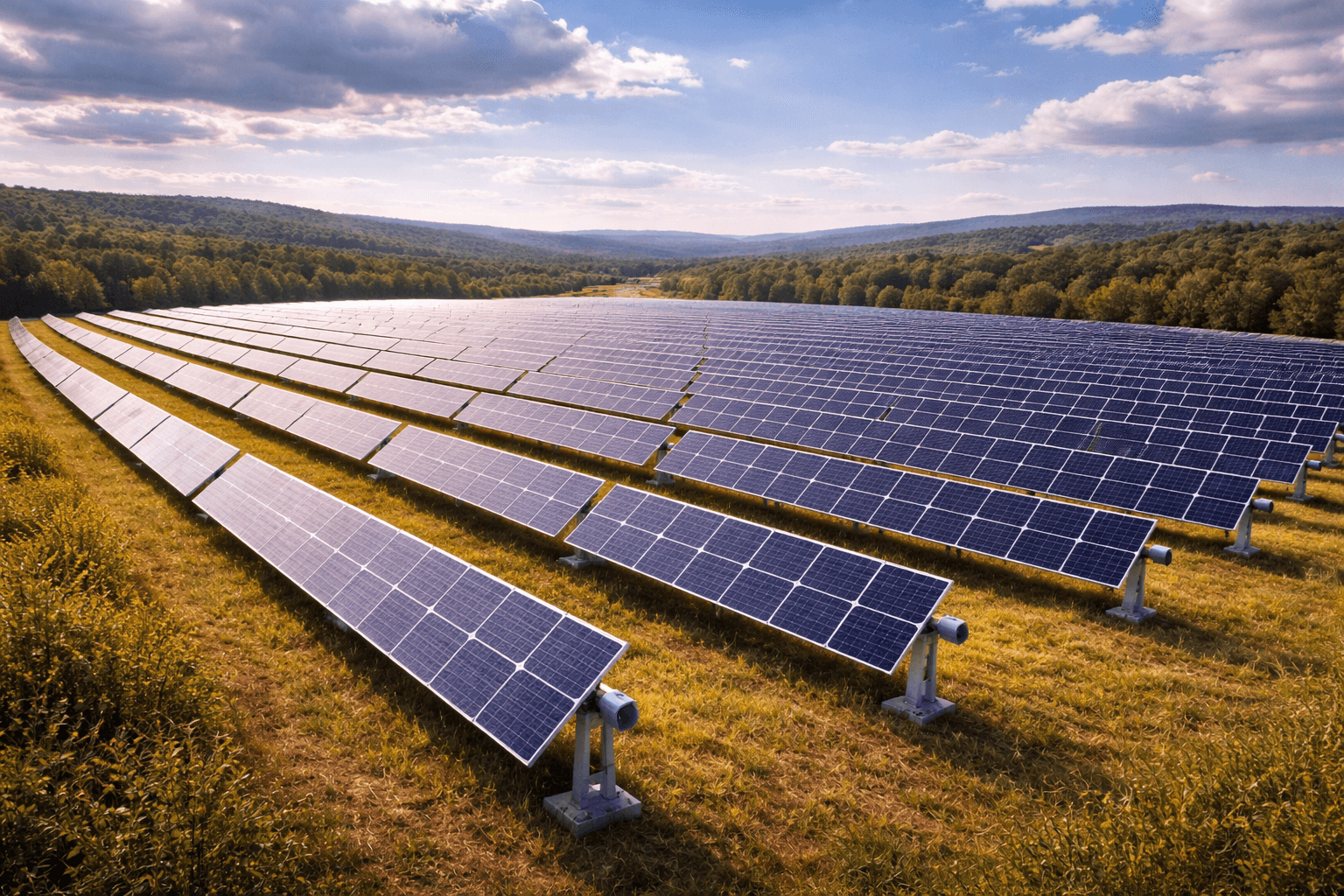
Why Traditional Solar Trackers Are No Longer Enough for Utility-Scale PV
Solar tracking systems have become the standard choice for utility-scale photovoltaic farms. By following the sun’s position throughout the day, trackers significantly increase energy yield compared to fixed-tilt structures.
But as solar farms grow larger, more complex, and more exposed to market and climate volatility, the limitations of traditional tracking technology are becoming increasingly clear.
The Hidden Inefficiencies of Conventional Solar Trackers
Most solar trackers on the market today are built around a simple assumption:
maximizing production means pointing panels directly at the sun.
In reality, utility-scale PV operates in a far more complex environment.
Diffuse Light and Cloud Cover
In many regions, a significant portion of annual solar irradiation comes from diffuse light, not direct sunlight. Conventional trackers ignore this factor entirely, often maintaining suboptimal panel angles during cloudy conditions. The result is measurable energy loss over the lifetime of a solar farm.
Single Points of Mechanical Failure
Traditional single-axis trackers typically rely on a central motor and gearbox to move an entire row of panels.
While efficient on paper, this design introduces a critical weakness:
a single mechanical failure can stop dozens or even hundreds of modules at once, increasing downtime and O&M costs.
Limited Adaptability to Grid and Market Conditions
Modern energy systems demand flexibility. Yet most trackers operate in isolation from:
electricity price signals
grid congestion constraints
curtailment requirements
This lack of adaptability reduces both operational control and economic efficiency.
Why the Industry Is Moving Toward Intelligent Solar Tracking
As PV farms scale into hundreds of megawatts, operators and investors are increasingly focused on:
long-term yield stability
predictable O&M costs
asset resilience
data-driven optimization
This shift is driving demand for intelligent solar tracking systems that go beyond simple sun-following.
Local Optimization Instead of Global Assumptions
Conditions vary across a solar farm. Terrain, shading, wind exposure, and cloud movement can differ from row to row.
A one-size-fits-all tracking strategy is no longer sufficient.
Reliability as a Core Design Principle
Reducing single points of failure and enabling predictive maintenance are now essential—not optional—for utility-scale PV assets expected to operate for 25–30 years.
The Role of AI in the Next Generation of Solar Trackers
Artificial intelligence is increasingly used in energy forecasting and grid management. Its application at the tracker level, however, is only beginning.
AI-enabled solar tracking allows:
real-time adjustment to changing weather conditions
learning from historical performance data
optimization beyond simple astronomical calculations
early detection of mechanical anomalies
When combined with robust mechanical design, AI can significantly improve both energy yield and operational resilience.
What This Means for the Future of Solar Farms
The next generation of utility-scale PV will not be defined solely by cheaper panels or larger inverters.
It will be shaped by intelligent infrastructure capable of adapting to real-world conditions—technically, economically, and environmentally.
Solar trackers are no longer just mechanical structures.
They are becoming active, data-driven components of modern energy systems.
Looking Ahead
As the solar industry continues to mature, solutions that integrate intelligent control, advanced mechanics, and system-level thinking will define the new standard.
At Soltracker AI, we are preparing to introduce a solar tracking solution designed specifically for this future—focused on adaptability, reliability, and long-term value creation.